
Bacterial Spot of Pumpkin. During the
past few days, bacterial spot was observer in some of pumpkin fields in central
Illinois. I estimated 2 to 5% percent of fruit with bacterial spot symptoms.
As long as there is no rain, the disease may not spread onto the healthy fruit.
But if it rains, the disease could spread rapidly. In order to prevent further
fruit infection, I recommend to collect and store the already orange pumpkins
in dray areas. If there are still green pumpkins in the field, spray application
of a cooper compound will help to reduced fruit infection. There are several
copper compound that can be used to reduce fruit infection. I recommend using
the highest rate of copper in 40 to 50 gallons of water per acre. Also, I highly
recommend using an sprayer that provide enough pressure to force the spray into
the canopy to provide a though coverage of fruit. If fruit are not throughly
covered with the spray, infection will take place and the disease will spread.
Bacterial spot, caused by the bacterium Xanthomonas campestris pv. cucurbitae,
is a serious disease of cucumbers, gourds, pumpkins, and summer and winter squash.
Severe outbreaks of the disease on jack-o-lantern pumpkins can result in near
total losses of crops. In 2000, yield losses caused by this disease exceeded
50% in some fields in Illinois. In 2001, this disease was observed in only some
pumpkin fields in early September. However, due to high levels of moisture,
considerable yield losses occurred in some fields in late September.
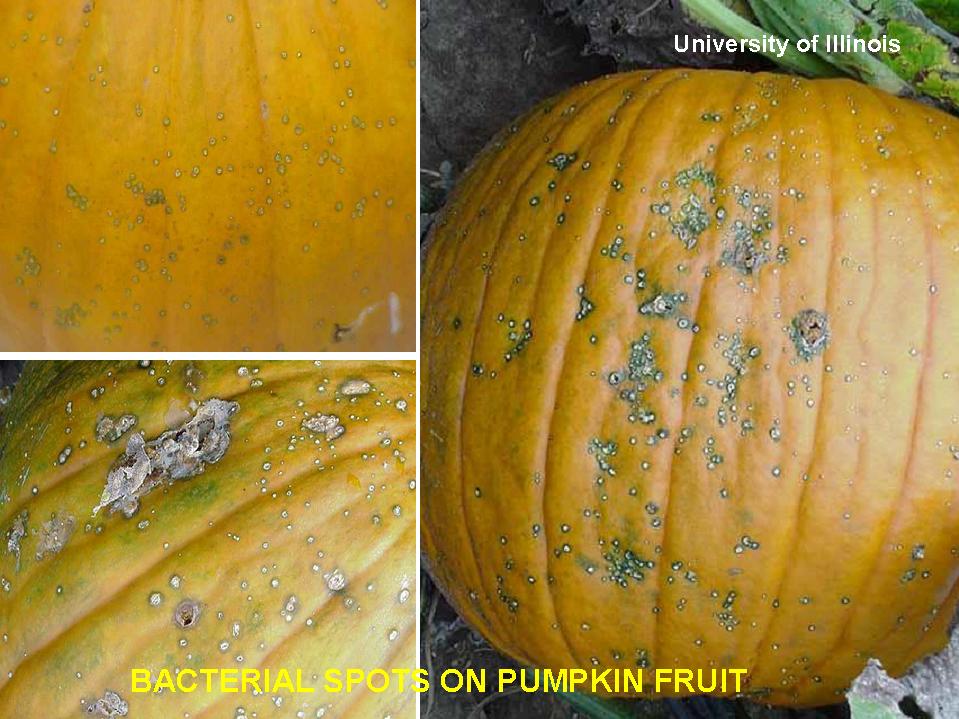
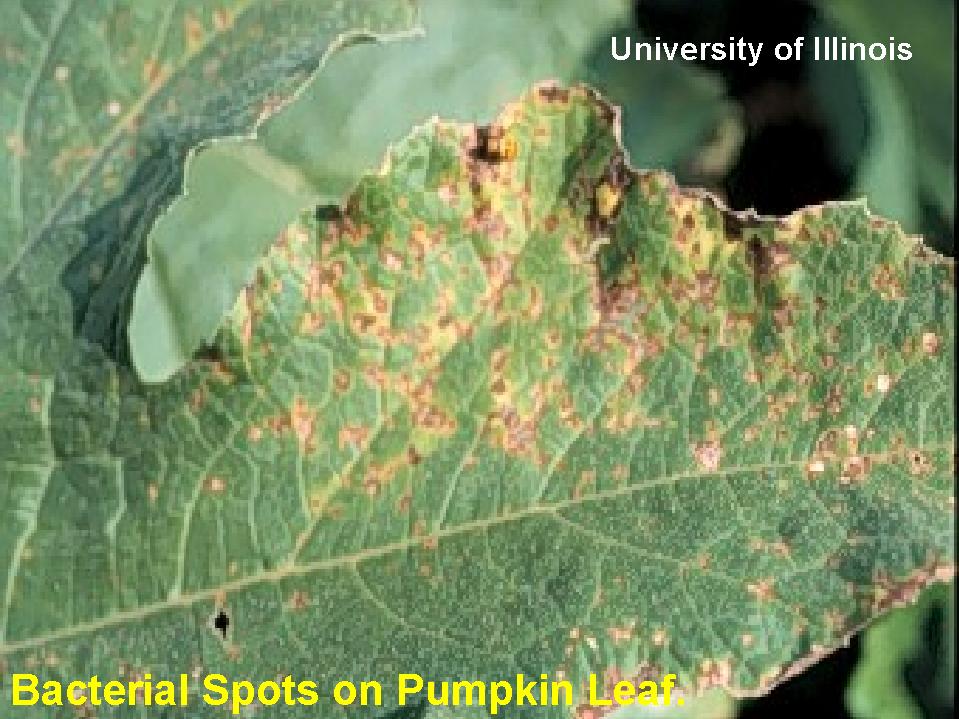
Symptoms. Field diagnosis of the disease is based on the characteristic symptoms developed on leaves and fruit. Symptoms on leaves appear as small, dark, and angular lesions. Center of the lesions gradually become translucent. The lesions may grow and cause serious foliar blight. However, because of their small size, leaf symptoms can easily be overlooked. The most readily identifiable symptoms occur on fruit. The appearance and size of fruit lesions can vary, depending on rind maturity and the presence of moisture. Initial lesions are small, slightly sunken, circular spots, 1/16 to 1/18 inch in diameter, with a beige center and a dark- brown halo. Later the cuticle and epidermis crack, and the lesions enlarge, reaching up to ½ inch in diameter. The large lesions may have scab-like appearance and give rise to tan, raised blisters. On mature fruit, saprophytic fungi often colonize the dead, tan tissue at the center of the lesion. Penetration of the bacteria into the flesh can lead to significant fruit rot in the field or later in storage.
Epidemiology. The bacterium is a seedborne pathogen. Also, the
bacteria can survive in association with infested crop residue. The disease
appears during the summer months when temperatures are high, and most commonly
after heavy rain or overhead irrigation. Fruit infection occurs through natural
opening in young, rapidly expanding fruit prior to the development of thick,
waxy cuticle. The bacteria are splash-spread in the field. Spread of the bacteria
within fields can be very rapid. Long distance dispersal of the pathogen is
by contaminated seed.
Disease Management. The most effective method for control of the
disease is planting pathogen-free seed. Do not save seed from previous crops
because the seed more likely harbors bacteria. Rotation with noncucurbit crops
is effective in management of the disease, unless inoculum is introduced via
contaminated seed. Application of copper compounds during early formation and
expansion of fruit may result in substantial fewer symptomatic pumpkins. M.
Babadoost (phone: 217-333-1523; email: babadoos@uiuc.edu; websit: http://babadoost.cropsci.uiuc.edu).